It's tough to scroll online these days without running into some version of this claim:
““Big investors are buying up all the homes.”
”
If you’re a buyer who’s already missed out on a few offers, that idea probably feels true. When prices are high and competition is fierce, it’s natural to think big companies are quietly grabbing every listing.
But here’s the catch: what people think is happening and what the data actually shows don’t always match up.
Let’s break down what large institutional investors are actually doing in today’s housing market—the data paints a very different picture than the headlines.
The Number Most People Won’t See Online
Let’s begin with the key stat: John Burns Research & Consulting reports that large institutional investors—those owning 100 or more homes—accounted for just 1.2% of all home purchases in Q3 2025.
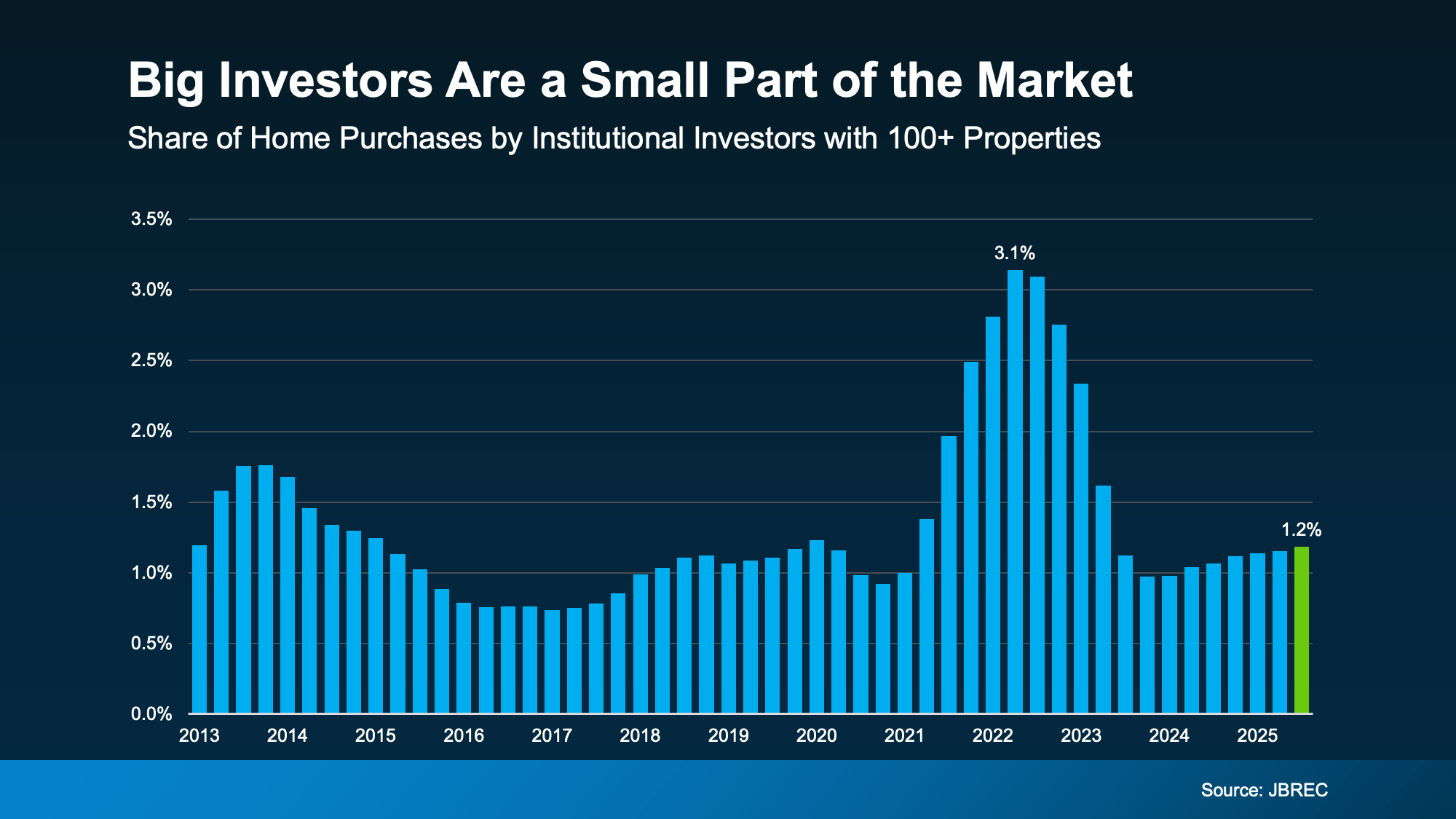
Out of every 100 homes sold, only about one went to a big institutional investor.
Here’s an important point people often miss: that level of investor activity is actually normal compared with history. It’s not unusually high and is well below the recent peak of 3.1% in 2022 — which itself was still only a small slice of the overall market.
Even though big investors seem to be everywhere, they actually make up only a small portion of home sales nationwide.
Why Investor Activity Gets So Much Attention
Two main reasons explain why this topic draws so much attention:
1. Investor activity isn’t evenly distributed — some markets see much more investor interest, so competition can feel intense for homebuyers in those areas. As Lance Lambert, co-founder of ResiClub, explains:
““On a national level, “large investors”—those owning at least 100 single-family homes—only own around 1% of total single-family housing stock. That said, in a handful of regional housing markets, institutional and large single-family landlords have a much larger presence.””
2. “Investor” covers a lot of ground. Headlines often lump huge Wall Street firms together with small, local owners — like your neighbor who owns one or two rentals, and that makes the investor share sound much larger and more monolithic than it really is. Most investors are actually small, local landlords, not giant corporations. When all investors are counted as one statistic, it can make it look like big institutions are dominating the market, even though they usually aren’t.
Yes, big investors do buy homes. But across the country, they account for only a tiny slice of all purchases — much less than most people think.
The real affordability problem comes down to supply and demand and decades of underbuilding, not big institutions outbidding regular buyers.
That’s why it’s important to tune out the noise and focus on what actually matters when you’re deciding whether now is the right time to move.
Bottom Line
If you want to walk through what investor activity really looks like in our local market—and how it could affect your options (or not)—let’s connect.
Sometimes knowing a bit of background changes everything.