For many homebuyers, the coming year should be more affordable, even though home prices are still rising for sellers.
Affordability should improve because mortgage rates are expected to be lower on average in 2026. That means monthly payments are projected to fall — the first decline we've seen since 2020.
Also, incomes are expected to rise, so the portion of monthly paychecks buyers need to cover a typical home will fall below 30%. That continues the small affordability gains from 2025 and brings costs under this important threshold for the first time since 2022.
Making housing more affordable should encourage more sellers to return to the market, increasing inventory by about 9%. It will also help buyers and sellers find common ground more often, nudging transactions up roughly 1.7%.
For renters, I think we'll see more rent relief coming, but keep in mind that rental and for-sale markets still differ a lot from place to place — you can check local trends in our Realtor.com® 2026 Housing Forecast.
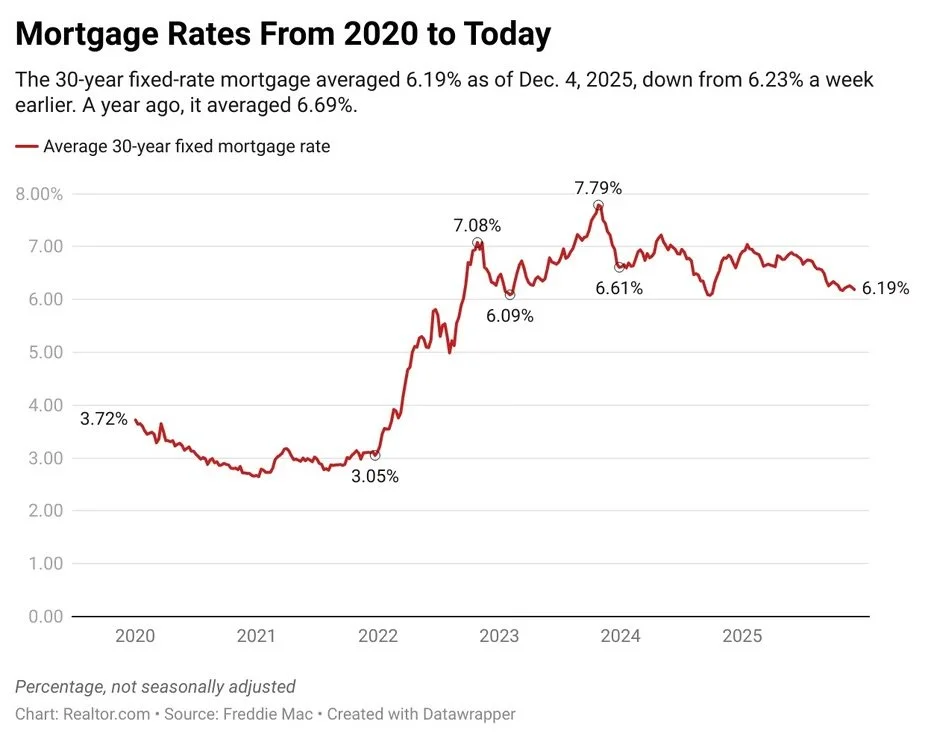
We expect mortgage rates to stay low, and this week they fell by 4 basis points, edging toward the lower end of the narrow range they've been in since mid-September — among the lowest levels we've seen since October 2024.
Mortgage rates on a 30-year fixed loan fell again, averaging 6.19% for the week ending Dec. 4, Freddie Mac reports — down from 6.69% at the same time last year.
In mid-November, rates ticked up as markets grew unsure a December Fed rate cut would happen. Now that the meeting is near, investors generally expect the incoming data will be enough for most committee members to back a cut, even though opinions on the right Fed policy rate still differ.
Simply put, even if the Fed cuts rates at next week’s meeting, I don’t expect mortgage rates to move much. We may see more ups and downs as delayed economic data from the government shutdown comes out, but for now mortgage rates are holding steady.
Weekly housing trends have been pretty steady. Prices are roughly flat—down a bit this week—as new listings slowed and the growth in active listings eased. Homes are taking about two extra days to sell compared with this time last year, closing the gap with the faster pace we saw earlier in the year.
Let’s take a closer look at luxury trends in two pandemic-era hot spots: Nashville, TN, and Austin, TX. The two markets share a lot of similarities, but as the national luxury market has cooled recently, Nashville’s high-end segment has stayed steady. Although both cities had similar luxury price points in 2018, Nashville’s top tier now runs more than $250,000 higher.